
We lounged under the warm sun, cool cider in hand. Friends dotted the patio of Anna’s Cider as we waited for Fr. Jorge to arrive. But we didn’t mind, the cider and company was enough. According to a college student, Fr. Jorge is frequently seen speeding past, cassock flying, late for some event or meeting. Originally from Argentina, Fr. Jorge Jesus Lopez became a chaplain at Thomas Aquinas College in October. A lover of academics, Father holds a doctorate in philosophy, a masters in bioethics, and a doctorate in moral theology.
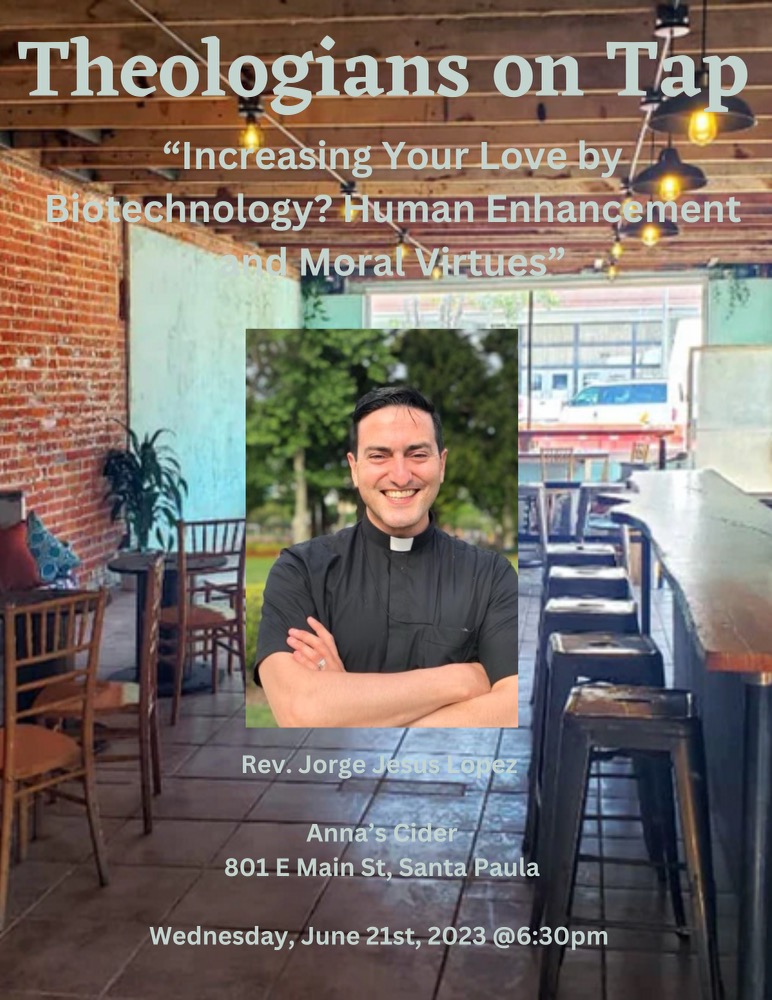
When Fr. Jorge finally arrived, I set him up with a stool and small mic system. Normally speaking with a soft voice, I was surprised when Father shunned the mic and began his talk in a clear, booming voice. He spoke with paced authority. His talk centered around the ethics of human enhancement, particularly around love and sex. The question became, “Is it ethical to use human enhancement for love?”
The discussion moved through various concepts: the definition of love and well-being, the nature of a virtuous relationship, and the physical and psychological implications of such a “love drug”. Fr. Jorge questioned the use of drugs like Viagra or the altering of hormones for a psychological connection. Is it ethical to use a drug which make sex physically possible? It is ethical to use a drug which will make someone sexually attracted to their partner? The concern for such a drug is addiction, the “medicating” of sex, or use in an abusive relationship. But what if it is used for the well-being of a couple in a healthy relationship?
Father finished his talk with that open-ended question. The Q&A touched on how such a “love drug” would affect the body, the purpose of sex in a marriage, and possible implications for same sex attraction. It was a complex topic, and the conclusion (as I understood it) was this: Human enhancement is moral as long as it is used as support in a virtuous relationship.
 Spirited Lamb